Nobody Could Get to Tuas: A Singapore Marine Services Operator's Remote-Only Problem
An illustrative Singapore composite: a marine and offshore services operator split between a CBD office and a Jurong-Tuas yard, whose remote helpdesk covered the office perfectly and the yard not at all. Why remote-first is right but remote-only is not, the real published Singapore dispatch and dedicated-engineer rates, the break-even arithmetic between them, and the three ways to cover the physical half of IT.
Published
TL;DR: A Singapore marine services operator's IT helpdesk was genuinely excellent — responsive, competent, well-run, and entirely remote. It still could not re-seat a failed switch in a workshop cabinet or swap a ruggedised terminal in the yard. Remote-first is right. Remote-only is a different thing, and the difference only shows up in the small percentage of tickets that need hands.
This is an illustrative composite based on the shape of problem Singapore two-site operators bring to Brocent. It is not a named client. The rates quoted are real published figures from Brocent's own dispatch and onsite catalogue, and they are quoted in the currency the catalogue uses.
Two sites, two completely different IT problems
Our composite operator is a marine and offshore services company of somewhere between 120 and 200 people, split across two locations that have almost nothing in common operationally.
The commercial office sits in the CBD: commercial managers, chartering, finance, procurement, HSE administration. It looks like any professional office. People have laptops, use email and a document management system, join video calls, and file things. Remote IT support works here almost perfectly, because almost every problem is a software problem happening to a person sitting at a desk with working connectivity.
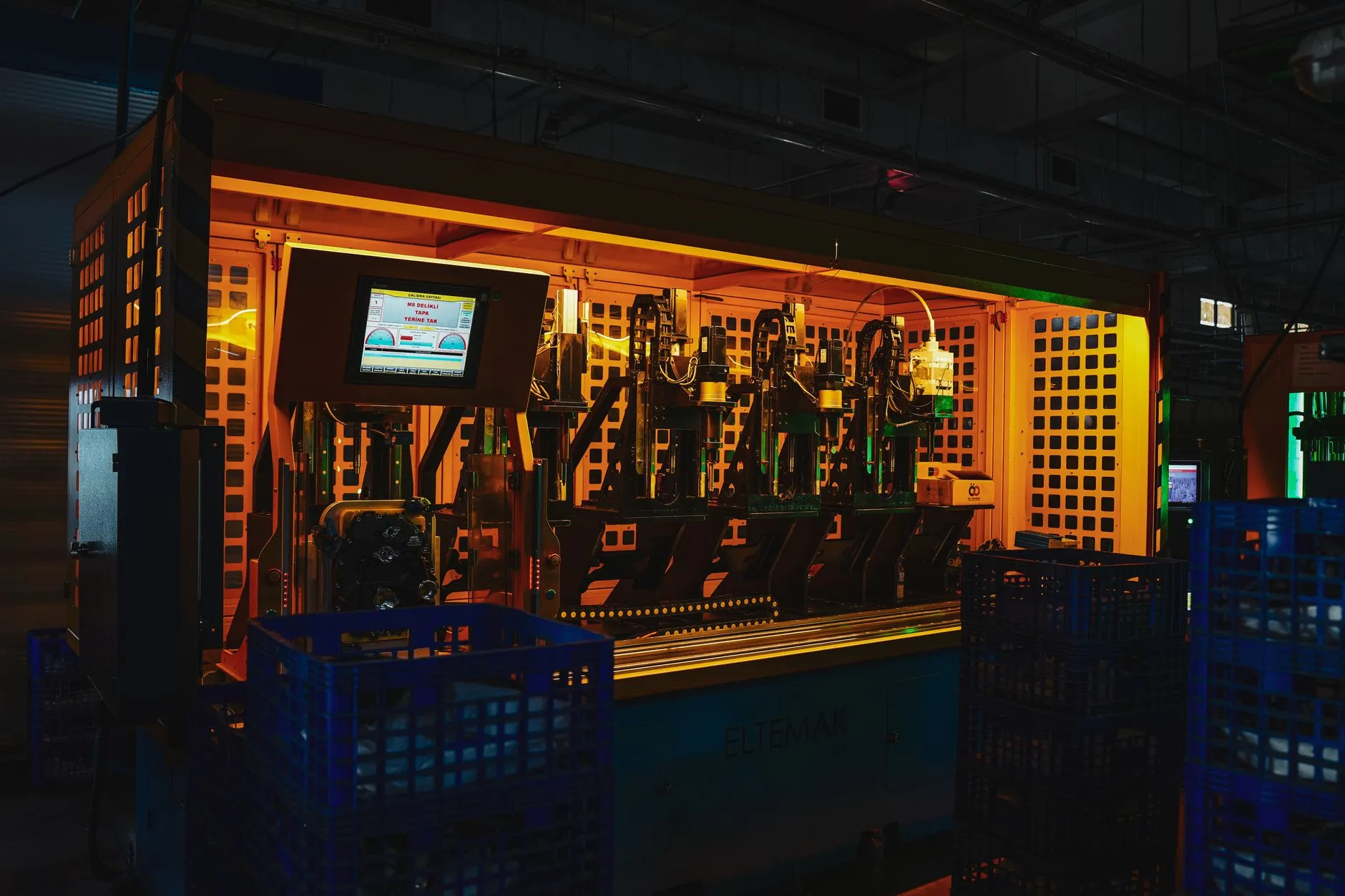
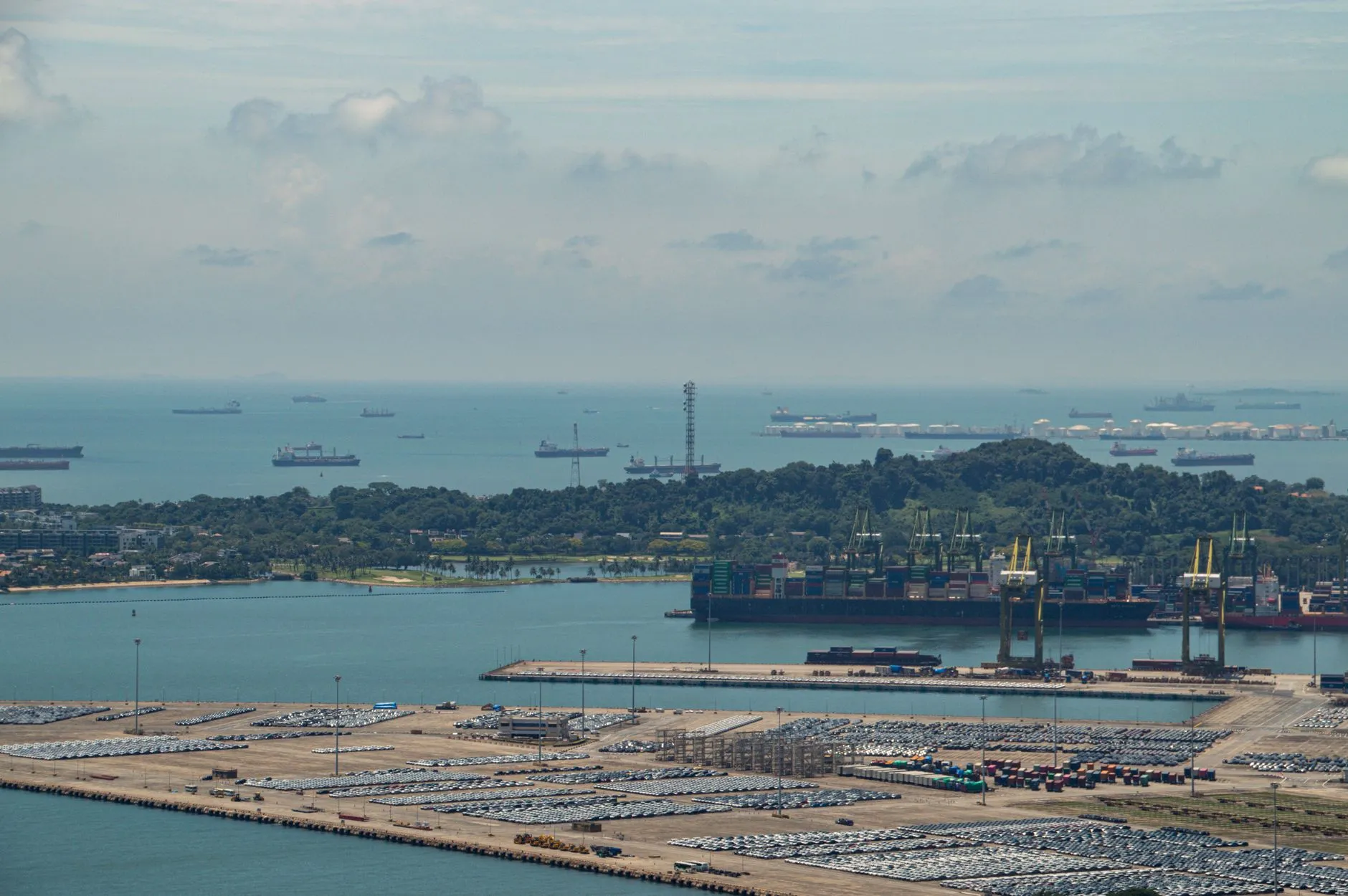
The yard is in the industrial west — the Jurong and Tuas side — and it is a different country as far as IT is concerned. There is a workshop, a stores area, a small site office, and a lot of people who are not at desks. The environment is actively hostile to equipment: dust from grinding and blasting work, humidity that never really goes away, salt in the air, and the everyday physical knocks of a place where things are moved by forklift. Hardware here does not fail the way office hardware fails. It fails because something hit it, or because a fan packed itself with dust, or because a cable got walked on for eight months.
And the yard does not run office hours. Shift work means "business hours" is a fiction: a handover at 07:00, a second shift running into the evening, occasional weekend work when a job has a deadline. A printer that cannot produce a work pack at 06:45 is not a low-priority ticket at the yard, whatever the ticketing system says.
The stores and workshop also run on equipment that office IT advice rarely contemplates: ruggedised handheld terminals for stock movements, a label printer that is load-bearing for the whole receiving process, industrial-grade switches living in a wall cabinet in a workshop, and wireless access points mounted where nobody can reach them without a ladder and a permit to work at height.
The scenario: a helpdesk that could do everything except be there
The operator's incumbent arrangement was a well-regarded managed service with an offshore delivery centre. To be explicit, because this matters: the helpdesk was good. Fast pickup, competent engineers, sensible escalation, proper documentation. The office team liked them. Nobody was being ripped off.
The problem was structural, and it showed up in a pattern the yard manager eventually started writing down.
A switch in the workshop cabinet dropped one of its ports. Remote diagnostics established, correctly, that the port was dead and the device needed physical attention. Then nothing happened for nine days, because arranging physical attention required finding a contractor, getting a quote, raising a purchase order, and scheduling a visit — a process that involved four people, none of whom owned it.
A ruggedised terminal was dropped and stopped charging. The remote team could not do anything at all. It sat in a drawer for three weeks while the stores team worked around it by borrowing a second terminal from the other shift, which meant the other shift was now short.
A wireless access point covering the far end of the workshop started dropping clients intermittently. Remote monitoring flagged it. Diagnosing it properly required somebody to stand underneath it with a laptop, which nobody did for a month, during which the stock-movement scanning in that half of the workshop just quietly stopped being reliable and people went back to paper.
None of these were catastrophes. That is precisely why they accumulated. Each one was individually tolerable and collectively corrosive, and the pattern had three downstream effects that cost far more than the incidents themselves.
Temporary workarounds became permanent. The borrowed terminal, the paper fallback, the extension lead running across a walkway to a switch that should have been in the cabinet. Each was a sensible response to a specific delay, and each outlived the delay by months.
A pile of broken equipment grew in the corner. Nothing was ever formally decommissioned, because decommissioning requires somebody to physically assess it. So the stores area accumulated a shelf of devices in an unknown state — some repairable, some not, all of them still on the asset register, none of them with a documented disposal.
The office team absorbed yard IT as an unofficial second job. This is the cost that never appears anywhere. One of the procurement coordinators, who was mildly technical and helpful, became the de facto first line for the yard. He did not want the job, was not trained for it, had no budget for it, and was doing it instead of his actual work. When he took two weeks of leave, the yard's IT effectively stopped.
Remote-first is right. Remote-only is the mistake.
It would be easy to read the above as an argument for putting engineers on site. That is not the argument, and overcorrecting is expensive.
The overwhelming majority of IT tickets genuinely should be resolved without anyone travelling. Remote resolution is faster for the user, cheaper for the business, and better for the engineer, who can work on three problems in the time a site visit consumes. Any provider pushing site visits as a default is either not very good at remote support or is billing by the visit. A managed IT plan that covers monitoring, patching, the help desk and the security baseline remotely is the correct foundation, and it is where the value is.
But the value of a provider is not set by the ninety-odd per cent of tickets that resolve remotely. Everyone can do those. The value is set by what happens with the small percentage that cannot, because those are the tickets that generate the nine-day gaps, the workarounds, the shelf of unknown hardware, and the procurement coordinator doing a job he was never given.
Three things have to be true for that small percentage to work.
There have to be engineers in the country. Not a partner arrangement negotiated after the ticket is raised — an existing capability with existing people. Singapore is Brocent's global headquarters, at 151 Chin Swee Road, which is a plain statement of presence rather than a claim about response times.
The economics have to be published in advance. If you cannot find out what a visit costs until you need one, you will hesitate before requesting one, and hesitation is exactly how a nine-day gap starts. Published rates remove a decision from the critical path.
Somebody has to be honest about travel time. We are not going to publish a guaranteed travel time to Tuas, or to anywhere else, and you should be sceptical of anyone who does without knowing your site, your access procedures and your escort requirements. An industrial site typically has a gate process, an induction requirement and sometimes a permit regime. The right conversation is about how the visit is arranged, not about a number that ignores the gate.
What the two real options cost
Brocent publishes dispatch and dedicated-engineer rates per country. A note on currency before the numbers, because it matters and mixing them silently would be misleading: these onsite rates are quoted in US dollars, whereas the per-user managed IT plan pricing for Singapore is quoted in Singapore dollars. They are different catalogues with different denominations. Do not add them together without converting.
Option one: field dispatch
The published Singapore rate is US$85 for the first hour and US$78 for each additional hour on the dispatch and onsite rates page. The published qualifications matter as much as the figure: these are indicative 2026 rates for level-one end-user-computing support, next business day, 9×5, tax exclusive, city centre, and they fall at higher volumes. They are described as fully loaded — covering cost of living, bilingual engineers, training, FX and tax handling, credit-term financing and round-the-clock coordination — rather than being a bare hourly wage with surcharges hidden behind it.
Read that "next business day, 9×5" carefully, because it is the honest part. The published rate does not buy a same-day emergency response and it does not buy shift coverage. If your yard needs 06:45 on a Saturday, that is a different conversation with different economics, and any provider quoting you a standard rate for a non-standard requirement is setting up an argument later.
For a sense of scale, the same catalogue puts Hong Kong at US$98 first hour and US$78 additional, Malaysia and mainland China at US$65 and US$59, and Japan at US$130 and US$117. Singapore sits where you would expect a high-cost, high-capability market to sit.
Working the arithmetic out: a one-hour visit is US$85. Two hours is US$163. A half-day of roughly four hours is US$319. A full eight-hour day is US$631.
If the work is being drawn from prepaid tokens rather than billed per visit, note two published surcharges that are specifically relevant to a yard: remote-site travel adds one token under 30 km and two tokens for 30–50 km, capped at two per visit, and transporting a heavy part such as a server or network chassis adds a token. Those are real line items, published rather than discovered on an invoice.
Option two: a dedicated onsite engineer
The published Singapore rate for a full-time onsite engineer is US$4,160 per month. For regional context from the same table: India US$624, Vietnam US$1,625, Malaysia US$1,820, mainland China US$2,730, Singapore US$4,160, Hong Kong US$4,810, Japan US$5,720.
The comparison against dispatch is straightforward arithmetic and worth doing explicitly, because operations managers usually assume a dedicated engineer is a luxury and are sometimes wrong.
At US$631 for a full day of dispatch, US$4,160 buys about six and a half dispatched days a month. Looked at another way, the marginal dispatched hour is US$78, so the dedicated-engineer cost is roughly equivalent to about 53 additional hours of dispatch.
So the decision rule is not complicated. If your genuine physical-attendance need is one or two days a month, dispatch is clearly cheaper and you should not be buying a person. If it is consistently more than about six or seven days a month — which is what a two-site operation with a busy yard often turns out to have once somebody actually counts — the dedicated engineer is cheaper *and* better, because a person who is there every day does the preventive work that never generates a ticket: checking the cabinet, cleaning the fans, noticing the cable, decommissioning the shelf.
The critical word in that paragraph is counts. Most operators in this position have never measured their physical-attendance demand, because the demand was being suppressed — absorbed by the procurement coordinator, deferred into workarounds, or quietly abandoned. The first month of honest measurement usually produces a bigger number than anyone expected.
If the dedicated-engineer route is where you land, the mechanics of embedding one person into a specific operation — what they own, who they report to, how the role is scoped — is a subject in its own right, and we wrote up a Singapore example in staff augmentation for a Singapore manufacturer.
Can one engineer cover two sites?
Often yes, and for our composite operator this is the shape that actually fits: a person based at the yard, where the physical work is, travelling to the CBD office on a routine basis for the things that genuinely need hands there. It works when the office's physical needs are light — which they usually are, because office problems are software problems — and the yard's are not.
It stops working when both sites have simultaneous physical demands, or when the yard's shift pattern means one person cannot cover the hours that matter. At that point the honest answer is either a second person, a plan plus dispatch for overflow, or an explicit decision that some hours are not covered. All three are legitimate. Pretending one person covers two sites across three shifts is not.
Three ways to cover the physical half
- Remote-only helpdesk. *Genuinely suits:* single-site office businesses where essentially every problem is a software problem. *What you are accepting:* every physical fault becomes a scheduling negotiation with somebody outside the contract, a growing set of workarounds, and an undocumented internal person absorbing the gap. *The tell:* a shelf of broken equipment nobody has assessed, and a helpful non-IT employee everybody calls first.
- Ad hoc local contractor. *Genuinely suits:* genuinely rare physical needs, or highly specialised one-off work. *What you are accepting:* per-event procurement, no continuity of knowledge between visits, no relationship with whoever is running your remote support, and a rate discovered per job rather than known in advance. *The tell:* the same problem gets diagnosed from scratch by a different person each time.
- Managed plan with in-country engineers. *Genuinely suits:* multi-site operations, industrial environments, and anyone whose physical-attendance demand is more than occasional. *What you are accepting:* the onsite component is a real cost you can see, denominated separately from the per-user plan. *What you get:* published rates for both dispatch and dedicated cover, one provider holding the remote and physical halves of the same ticket, and preventive physical work that happens because somebody is actually there to do it.
Where our composite operator ended up
They did not fire the incumbent helpdesk for being bad, because it was not bad. They changed the shape of the arrangement so that the physical half of IT had an owner.
The measurement came first: one month of logging every ticket that needed hands, including the ones people had stopped raising. The number was larger than the office team's impression of it, which is the normal result. That measurement — not a sales conversation — is what decided the structure.
The yard got physical presence on a routine basis rather than on an exception basis. The shelf of unknown equipment was assessed and either repaired or properly decommissioned off the asset register. The workarounds were unwound one at a time, which took longer than fixing the original faults would have. And the procurement coordinator went back to procurement.
If you are running a two-site operation where one of the sites is a workshop, a yard, a warehouse or a plant, the useful first step is not a proposal. It is a month of honest counting. After that, the published dispatch and onsite rates and the managed IT plan pricing will tell you what your own number costs, and you can talk to us with a figure rather than an impression.
Brocent has been doing this since 2007, starting in Beijing, with a Hong Kong office since 2016 and Singapore as the group's global headquarters since 2021, reaching more than 100 countries through a global service desk and engineer network. We publish onsite rates for a reason: the moment you have to ask what a visit costs is the moment a nine-day gap starts.
Frequently asked questions
What genuinely cannot be fixed remotely?
Anything where the failure is physical or the device is unreachable. Re-seating or replacing a failed switch, swapping a dead power supply, replacing a ruggedised handheld that no longer charges, reachable-only-by-ladder access points, cabling faults, a workstation that will not power on, hardware that needs to be physically decommissioned, and any first-time installation of equipment at a site. Also, and less obviously: any diagnosis that requires somebody to observe the physical environment. A wireless problem that only occurs in one corner of a workshop is often not a wireless configuration problem at all, and no amount of remote telemetry will show you the new steel racking that went up last month.
How fast can an engineer actually reach Jurong or Tuas?
We will not publish a travel-time guarantee for any Singapore district, and we would encourage scepticism toward anyone who does before seeing your site. The published dispatch rates are quoted on a next-business-day, 9×5 basis, which is the honest baseline. Real attendance time at an industrial site depends on things outside any provider's control: your gate and security process, whether the engineer needs a site induction, escort requirements, and whether work at height or in a restricted area is involved. The productive version of this question is "what would it take to get an engineer on site within X hours, and what would that cost" — that has a real answer, negotiated against your actual access procedures.
What does an onsite visit cost in Singapore?
The published rate is US$85 for the first hour and US$78 for each additional hour, indicative for 2026, level-one end-user-computing support, next business day, 9×5, tax exclusive, city centre, and falling at higher volumes. Note the currency: onsite rates are quoted in US dollars while the Singapore per-user managed plan is quoted in Singapore dollars. If the work draws on prepaid tokens instead, remote-site travel adds one token under 30 km and two for 30–50 km, capped at two per visit, and transporting a heavy part such as a server or network chassis adds one.
When is a dedicated onsite engineer cheaper than dispatch?
At the published rates, a full eight-hour dispatched day works out to US$631, and a dedicated Singapore engineer is US$4,160 a month — so the crossover is around six and a half dispatched days a month, or roughly 53 marginal dispatch hours. Below that, dispatch is cheaper. Above it, the dedicated engineer is cheaper and also buys something dispatch cannot: routine preventive work that never becomes a ticket. Count your real demand for a month before deciding, and include the physical work people have quietly stopped asking for.
Do you cover shift hours and weekends?
Coverage outside 9×5 is available, but it is not what the standard published dispatch rate buys — that rate is explicitly next business day, 9×5. Out-of-hours attendance is priced differently, and under the token model the published multipliers are concrete: evenings carry a three-token minimum at 1.5 tokens per hour, late nights and weekends a four-token minimum at two tokens per hour, and public holidays a six-token minimum at three tokens per hour. Monitoring itself runs 24×7×365 on every managed plan tier, so alerts do not wait for Monday even when attendance does. If your yard genuinely needs regular pre-dawn or weekend physical cover, say so at proposal stage and get it priced explicitly rather than assuming the standard rate stretches.
Are your engineers employees or subcontractors?
This is a fair question to ask any provider, and the honest general answer across the industry is that global coverage always involves a mix — no provider has salaried staff in every one of a hundred-plus countries. What matters practically is who holds the relationship, the documentation and the accountability for the ticket, and whether the same person comes back. Ask specifically: who employs the engineer attending my site, do I get continuity of personnel, and who is accountable if the visit does not resolve the issue. A provider who answers that clearly is more useful than one who answers it flatteringly.
Can one engineer cover two sites?
Frequently, when the sites have asymmetric physical demand — which is the normal pattern for an office-plus-yard operation, because office faults are mostly software faults. Base the person where the physical work is and schedule routine visits to the other site. It breaks down when both sites need hands at once, or when shift patterns exceed what one person can cover. At that point the options are a second person, dispatch for overflow on top of the dedicated engineer, or an explicit decision to leave certain hours uncovered — and the last one is only a problem if nobody says it out loud.
What about hardware that is out of warranty?
It still needs somebody to physically assess it, which is the recurring theme. In practice, out-of-warranty equipment in an industrial environment splits three ways: things worth repairing, things worth replacing, and things that should be decommissioned and taken off the asset register. Nobody can make that split remotely, which is why the shelf of unknown devices grows under a remote-only arrangement. Getting it assessed is usually a single visit that pays for itself in removed confusion, and it should end with an updated asset register rather than a tidier shelf.
Share:
Ready to take action?
Turn these insights into a roadmap for your business.
Book a 15-minute no-obligation consultation with our APAC IT experts. We'll review your current setup and provide a tailored IT roadmap within 24 hours.
Free Checklist
10 Critical Checks Before Expanding IT to Greater China
PIPL compliance, network segmentation, bilingual helpdesk setup, and more — everything your IT team needs before Day 1 in China.
Request the checklist →📬 Monthly Asia IT Insights
China compliance updates, cybersecurity alerts, and IT tips for APAC teams — once a month.
No spam. Unsubscribe anytime.