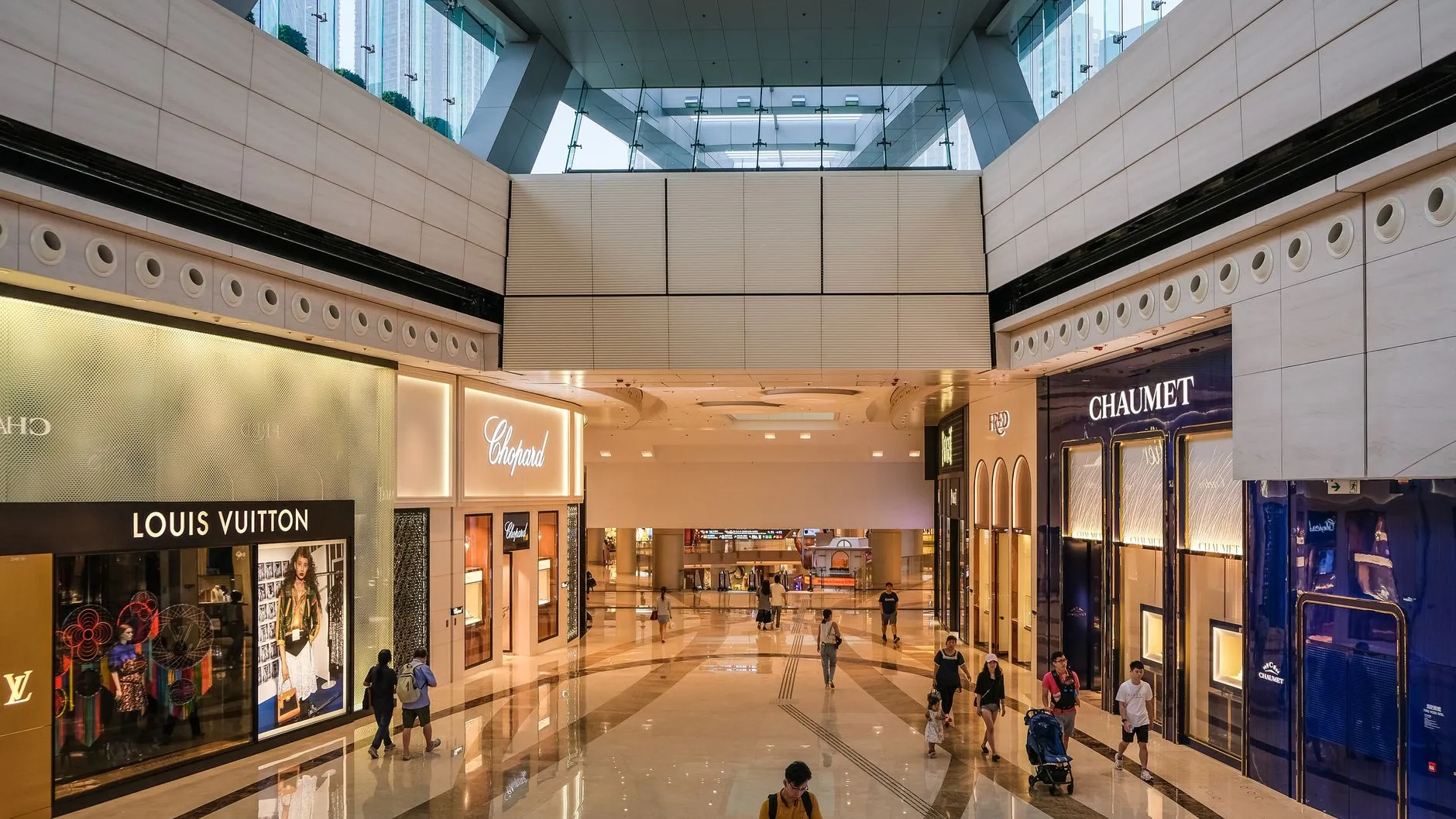
Opening Outlet Fourteen
A composite scenario from Hong Kong: a 13-outlet F&B group signs the lease for outlet fourteen and finds the phone system is the longest lead item on the fit-out. Why a growing chain has a numbering problem, not a hardware problem.
In short: A thirteen-outlet Hong Kong F&B group signed the lease for outlet fourteen and discovered that the phone system — not the kitchen, not the POS — was the longest lead item on the fit-out schedule. Every previous outlet had been set up as its own island, with its own line, its own handsets and its own number nobody at head office could route. A hosted PBX turns that from a procurement problem into a configuration task.
Why the phone line decides the opening date
Hong Kong multi-outlet F&B and specialty retail runs on fixed dates. A lease starts on a day. The landlord hands over the shell on a day. The licence inspection happens on a day. Staff are hired to start on a day, and the marketing for the opening is booked against a day. Everything in a fit-out schedule is negotiable except the handover, and the consequence is that whatever has the longest lead time silently becomes the thing that controls the calendar.
Operators expect that item to be kitchen equipment, or the shopfront, or the licensing. It usually is not. Kitchen equipment is ordered months ahead and everybody in the business knows to do it. Point-of-sale is a solved problem — the vendor has done a hundred of these and turns up with a configured terminal. The item that quietly slips is the one that nobody owns: the phone.
The reason is structural. Ordering a fixed line for a new commercial address in Hong Kong is not an instant transaction. It involves a service address, a survey in some buildings, an installation appointment, and a wait that is measured in working days rather than hours. Then the handsets need to arrive, be configured, and be tested. Then the number needs to be printed on the signage, listed on the delivery platforms, updated on the group's own site and given to the suppliers. None of these steps is difficult. All of them are sequential, and the sequence only starts once someone remembers to start it.
For a group opening two or three sites a year, this recurs. And because each opening is handled by whoever is running that project, each one gets solved locally — a new contract, a new number, a new set of handsets — which is precisely how a group ends up with thirteen unconnected phone systems and no way to see any of them.
The scenario: thirteen islands and a fourteenth on the way
Here is a composite picture. Not a named client — a shape that shows up repeatedly in this market.
A Hong Kong F&B group, thirteen outlets, built up over about six years. A mix of formats: a few larger sit-down restaurants across Hong Kong Island and Kowloon, several smaller counter-service sites in malls, and two in industrial-building conversions in Kwun Tong. Around two hundred staff in total, plus a head office of eleven people above one of the restaurants.
Each outlet has its own phone line, contracted separately at the time it opened. Some are with one carrier, some with another, on plans signed at different times under different terms. Nobody at head office has a consolidated view of what the group pays for telephony, because the bills arrive against different accounts and are approved by whoever handles that outlet's invoices.
There is no numbering plan. Each outlet has a public number that appears on its own signage and on the delivery platforms. Head office has its own line. There is no extension range, so the way a head-office manager reaches a store manager is by calling the store's public number and hoping someone who is not busy picks up, or more realistically by messaging the manager's personal mobile. In practice, the entire operational communication of a two-hundred-person business runs over personal instant messaging, and the phone system is only for customers.
Reservations reach whichever outlet a customer happens to call. If that outlet is full on a Friday evening, the person answering has no way to offer the table that is empty two MTR stops away, because they cannot transfer the call and do not know the other site's availability. The customer is told "sorry, we're full," and the group loses a booking it actually had capacity for.
There are no call records. When a customer complains that they called three times and nobody answered, the group has no way to check whether that is true. When a supplier says they confirmed a delivery change by phone, there is no record of the call. Every dispute is resolved by whoever sounds more confident.
And the hardware is a recurring write-off. When a lease ends and a site closes — which happens, in this business — the handsets are collected, put in a box at head office, and never used again, because the next site's line comes with its own equipment on its own contract.
Then the lease for outlet fourteen is signed, the fit-out schedule is drawn up, and the operations director asks a question nobody has asked before: why is the phone the long pole?
What this actually costs, beyond the invoice
Four costs, roughly in ascending order of how much they hurt.
The schedule dependency nobody can compress. This is the visible one. A new site cannot open without a working phone, the phone depends on a carrier installation, and the carrier installation depends on their calendar rather than yours. On a tight fit-out, this can be the difference between opening on the planned Friday and opening the following week — which is a week of rent against no revenue, and a marketing date that has to move.
Revenue that walks because a call cannot move. Harder to see, because it never appears as a loss. Every time a full outlet turns away a booking that another outlet could have taken, the group loses a table it had. Over a year, across thirteen sites and every busy Friday and Saturday, this is not a rounding error. It is invisible only because there is no mechanism that would have counted it.
Head office cannot reach the floor. A group of this size has genuine operational communication needs — a supplier issue, a staffing gap, a food-safety question, a delivery-platform outage. Routing all of it through managers' personal mobiles works until a manager is off, or leaves, or simply does not answer because it is 8pm and they are not on shift. There is no equivalent of "call the store and speak to whoever is in charge," because "the store" is a handset on a counter and "whoever is in charge" is not standing next to it.
Evidence that does not exist. Call records are not exciting until you need them. A customer complaint about a booking that was allegedly confirmed by phone, a supplier dispute about a delivery window, a staffing incident where the timeline matters — in each case the group's position rests entirely on what someone remembers. A hosted system produces the record as a by-product of operating.
Brocent's perspective: this is a numbering problem, not a hardware problem
The instinct when the phone becomes the bottleneck is to solve it faster — find a carrier who can install sooner, order handsets earlier, put it earlier in the project plan. That is treating the symptom, and it works exactly once, for the outlet you are currently opening.
The structural observation is different: a growing chain's phone system is a numbering and routing problem that has been mistaken for a hardware problem. What the group actually needs is not thirteen lines and a fourteenth. It needs one system with a numbering plan, in which an outlet is an entry rather than an installation.
Once that inversion happens, everything downstream changes shape. Adding an outlet becomes a configuration task measured in hours instead of a procurement task measured in weeks — which means the phone stops being on the critical path of a fit-out at all. Routing a call between sites becomes possible because the sites are on the same system. Head office can reach a store because a store is an extension, not a device. Call records exist because the system that carries the calls is the system that logs them.
This is the same principle Brocent applies to networks across multi-site operations — the value comes from consolidating the thing that was accidentally distributed, not from buying a better version of the distributed thing. It is the same argument behind IT vendor consolidation generally, applied to the one system a restaurant group interacts with every single day.
What this looks like in practice
Brocent's Managed Cloud PBX is a hosted phone system built on Alicloud, AWS and Azure, delivered with a 99.99% uptime commitment. For a multi-outlet group, six things about it matter more than the rest.
One hosted PBX with a group-wide numbering plan. Every outlet, plus head office, sits in a single extension range. A store manager has an extension. The kitchen has an extension. Head office finance has an extension. Anyone can reach anyone by dialling three or four digits, and any call can be transferred anywhere in the group. The public-facing numbers still exist and still point where customers expect — but underneath them is one system rather than thirteen.
Softphones, so staff use the devices they already carry. The UC soft phone delivers a consistent corporate call experience on Android, iPhone and desktop, with no dedicated physical desk phone required. For an F&B group this is the change that removes the hardware problem entirely: a duty manager carries the outlet's extension on the device already in their pocket, and it moves with them across the floor. Where a physical handset genuinely makes sense — a counter position, a back-office desk — it still can be used. The point is that it is now a choice rather than a dependency.
Auto attendant, IVR and call queue for the Friday-evening problem. The advanced feature set — auto attendant, call queue, conference, IVR, voicemail-to-email, toll-free 400 hotlines, hold music and advanced call routing — is included, not a bolt-on. In operational terms: a reservation line can present a menu, hold callers in a queue rather than ringing out, and overflow to a second outlet or to head office when the first does not pick up within a set time. That last behaviour is the one that recovers the bookings the group is currently losing.
Microsoft Teams integration through certified SBCs. Where head office already works in Teams, PBX telephony can be integrated into it using Microsoft-certified Session Border Controllers, so calls to extensions, landlines and mobiles can be made directly from Teams. Head-office staff sit on the same extension range as the outlets without carrying a second application. If the group also runs Teams for internal collaboration, Microsoft Teams solutions and the PBX end up being one deployment rather than two.
Local numbers across the region when the group crosses a border. Hosting includes local phone numbers in Hong Kong, mainland China, Japan and Singapore. For a group whose expansion plan includes a first mainland site or a Singapore test outlet, this matters at exactly the moment it becomes relevant — the new market gets a local number on the existing system rather than a fresh procurement exercise in an unfamiliar jurisdiction.
And the network underneath it. A hosted phone system depends on the connectivity at each site, which is why telephony and the site network should be scoped together rather than separately. Brocent's managed wireless network service covers that layer. The commercial shape is worth knowing when budgeting a rollout: the Network & Wireless add-on on Brocent's managed IT plans is priced in flat bands — one monthly fee covering up to 10 devices, re-banding at 11–30, 31–75 and 76+ — rather than as a straight per-device multiplier. For a small counter-service outlet that stays inside the first band, an additional site is genuinely a small addition. A large restaurant with a lot of connected equipment may cross into the next band, and it is better to know that during planning than at the first invoice.
Three ways to run phones across multiple outlets
Per-outlet phone lines — "each site buys its own"
- What it is: A separate carrier contract, number and set of handsets for every location, arranged when that location opens.
- What it costs: More than the sum of the bills, because the real costs are the fit-out dependency, the un-transferable call, the absence of any group-level view, and hardware written off at every lease end.
- Who it suits: A single site, or a group of two or three that genuinely never needs to move a call between them.
An on-premise PBX at head office
- What it is: The group buys PBX hardware, installs it at head office, and connects the outlets back to it. Central numbering, central control.
- What it costs: Capital up front, a maintenance relationship, and a single physical dependency — the box lives in one building, on that building's power and that building's connectivity. Adding an outlet means provisioning at the site and configuration at the centre. When head office relocates, the PBX relocates, which is its own project.
- Who it suits: Groups with a stable head office, an existing PBX with life left in it, and a preference for owning infrastructure. Brocent supports this path too — an existing PBX can be extended to remote offices and home workers rather than replaced outright.
Managed Cloud PBX — the model that fits a chain that is still opening sites
- What it is: The PBX is hosted on Alicloud, AWS or Azure with a 99.99% uptime commitment, priced per user per month. Outlets are extensions, not installations. Softphones on existing devices, physical handsets where they are wanted.
- What it costs: A recurring per-user fee instead of capital, plus the design work of the numbering plan and routing rules — which is done once and then extended, not repeated per site.
- Why it fits: Because the binding constraint for a growing chain is time-to-open, and this is the model where opening a site does not wait for anyone's installation calendar. It also removes the hardware write-off at lease end, and produces the call records the group currently does not have.
Where to start
For a group in this position, the useful first step is not a quote. It is a numbering plan on one page: what the extension ranges are, which public numbers stay as they are, what happens to a reservation call that is not answered in twenty seconds, and who at head office needs to be reachable from an outlet. That document is what makes the migration boring, and boring is the goal — the outlets should not notice the day it happens.
From there, the migration is usually staged: head office and one or two outlets first, then the rest in batches, with public numbers ported in a planned sequence rather than all at once. The commercial structure sits alongside the rest of a managed IT support arrangement, and the practical next step is a conversation about the estate as it actually is — talk to us.
Frequently asked questions
Can we keep our existing phone numbers?
In most cases yes — number portability is a normal part of moving to a hosted system, and it is one of the first things checked during scoping because it varies by number type and by the carrier the number sits with today. It matters commercially for a restaurant group, because the outlet numbers are printed on signage, listed on delivery platforms, saved in customers' phones and indexed on the web. Assume porting is the plan, confirm it per number during scoping, and sequence the cutover so no outlet is unreachable during the move.
What happens to a cloud PBX when the internet at one outlet drops?
Only that outlet's devices are affected — the rest of the group keeps working, which is already a meaningful improvement on a per-site system where a fault takes that site off the map entirely. For the affected outlet, the routing rules decide what customers experience: calls to that outlet can fail over to another site, to head office, or to a mobile, and the caller simply reaches a person somewhere else in the group. That failover behaviour is a configuration decision made during design, and it is worth making deliberately rather than discovering it during an outage. The 99.99% uptime commitment covers the hosted platform; the connectivity at each site is a separate layer, which is why the network should be scoped alongside the phone system.
Do staff need desk phones at all?
Not necessarily. The UC softphone runs on Android, iPhone and desktop, so a duty manager can carry the outlet's extension on the device they already have. Many groups keep a physical handset at a counter or back-office position where a shared, always-present device is genuinely more practical, and use softphones for everyone else. The useful shift is that handsets become an operational choice per position rather than a fixed cost per site.
How quickly can a new outlet be added?
Once the system exists, adding an outlet is a configuration task — extensions, routing, a number if one is needed — rather than a procurement task. The realistic dependency moves to the site's own connectivity and the fit-out of any physical equipment, not to the phone system itself. That is the change that takes the phone off the critical path of a fit-out schedule, which for a group opening two or three sites a year is the point of the exercise.
Does this work with Microsoft Teams?
Yes. PBX telephony integrates into Teams using Microsoft-certified Session Border Controllers, which enables calls to extensions, landlines and mobiles directly from Teams. For a group where head office already lives in Teams and the outlets do not, this is a good fit: head office keeps working the way it works, and the outlets are reachable on the same extension range.
What does a 99.99% uptime commitment actually mean for a restaurant?
It is a commitment on the hosted PBX platform — the part Brocent runs. In practical terms it means the phone system itself is not the thing you plan around; the variables you should plan around are each site's connectivity and your own routing rules. That is a better place for the risk to sit, because connectivity at a single outlet is a local problem with local remedies, whereas a central system going down is everyone's problem at once.
We only have thirteen outlets. Is a hosted PBX overkill?
The number of outlets is less relevant than whether you are still opening them. A stable group of thirteen that has not opened a site in three years and has no plan to may reasonably leave a working arrangement alone. A group opening two or three a year is paying the per-site setup cost repeatedly, and the case gets stronger with every opening, because the migration is done once and every subsequent site is nearly free of it.
What about the cost — is this more or less than we pay now?
Honestly, it depends on the estate, and any provider who answers this without looking at your bills is guessing. The structural change is that spend moves from thirteen separate carrier contracts plus periodic hardware to a per-user monthly fee on one system, which makes it visible and comparable for the first time. Brocent's service page carries indicative market-reference rates for extension types and SIP trunks ahead of a full pricing update, and the hosted PBX base fee is custom-quoted per deployment — final numbers are confirmed during scoping, against your actual outlet count and user count.
Share:
Ready to take action?
Turn these insights into a roadmap for your business.
Book a 15-minute no-obligation consultation with our APAC IT experts. We'll review your current setup and provide a tailored IT roadmap within 24 hours.
Explore all servicesFree Checklist
10 Critical Checks Before Expanding IT to Greater China
PIPL compliance, network segmentation, bilingual helpdesk setup, and more — everything your IT team needs before Day 1 in China.
Request the checklist →📬 Monthly Asia IT Insights
China compliance updates, cybersecurity alerts, and IT tips for APAC teams — once a month.
No spam. Unsubscribe anytime.